

Why Sensation May Be the Next Major Focus in Breast Reconstruction
For years, the conversation around breast reconstruction centered on shape, symmetry, and soft-tissue coverage. Those goals remain essential, but the field continues to evolve: according to the American Society of Plastic Surgeons, 162,579 breast reconstruction procedures were performed by ASPS member surgeons in 2024, underscoring the scale and continued relevance of post-mastectomy reconstruction.
What feels newer is the growing attention to something patients experience every day and increasingly ask about after surgery: sensation.
From contour restoration to functional reconstruction
Breast reconstruction is increasingly being discussed in broader terms than aesthetics alone. In addition to restoring contour, surgeons are paying more attention to how a reconstructed breast may feel and function from the patient’s perspective.
That shift reflects advances in reconstructive technique, growing interest in nerve preservation and neurotization, and a wider focus on life after treatment rather than surgery alone.
In practical terms, the conversation is moving from “Was the breast mound successfully restored?” to “How does the patient live with the result over time?”
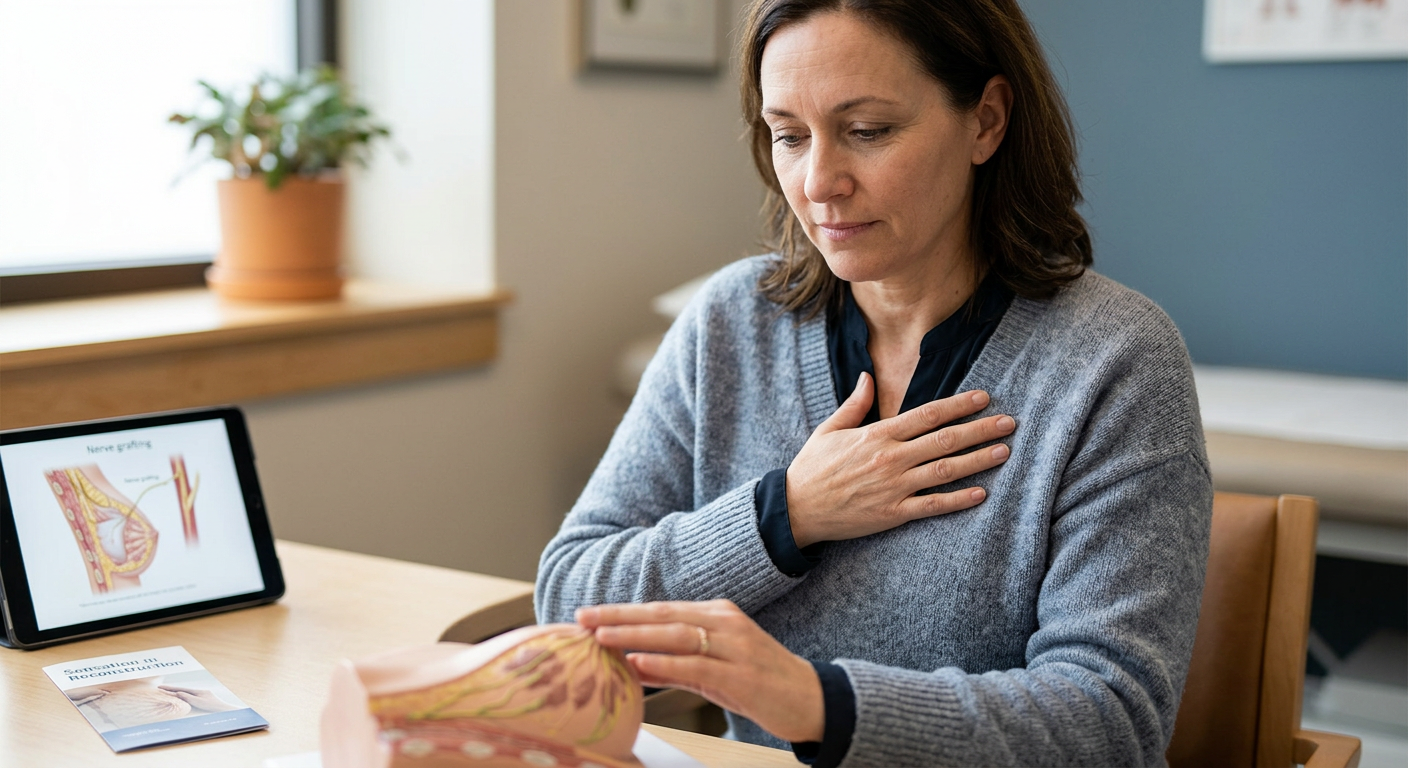
Why sensation has become a bigger topic
Loss of sensation after mastectomy is no longer being treated as a minor tradeoff. Recent reviews describe post-mastectomy sensory loss as an issue with potential psychological, sexual, and functional implications, which helps explain why sensory recovery is becoming a more meaningful endpoint in reconstruction.
In day-to-day terms, sensation is what allows a patient to feel the warmth of a shower, the pressure of a seatbelt, the brush of clothing against skin, or a hug from a partner or child. It also plays a role in safety—alerting a patient to heat, cold, or pressure that could otherwise go unnoticed. When that feedback is diminished or absent, the reconstructed breast can feel disconnected from the rest of the body, even when the visual result is excellent.
That matters because patients do not perceive reconstruction only as a visual result. They live with it physically and emotionally, in daily life, in recovery and in how connected they feel to their bodies after treatment.
As a result, sensory restoration is increasingly being discussed not as an added bonus, but as part of what a better reconstructive outcome may look like.
What the research is showing
The evidence base is promising, although it is still developing.
A narrative review in Annals of Translational Medicine found that neurotization techniques were associated with earlier and superior sensory recovery compared with non-innervated reconstruction, while also noting that the literature remains limited by heterogeneity and a lack of high-quality comparative trials.
A 2024 review in Journal of Clinical Medicine similarly emphasized that breast sensation affects both patient safety and quality of life and noted that abdominal flap neurotization remains relatively uncommon despite encouraging findings around reinnervation.
Taken together, these findings suggest that nerve recovery is becoming a more visible outcome in breast reconstruction research, even if best practices and measurement standards are still being refined.
The measurement challenge
Part of what makes this area so compelling is that surgeons are not only trying to improve sensory outcomes, but also to define how to measure them more meaningfully.
Recent literature repeatedly calls for more standardized sensory testing, stronger comparative studies, and better integration of patient-reported outcomes into reconstructive research.
That need for better evidence is one reason this still feels like a frontier topic rather than a settled one. The clinical interest is real, but the field is still working toward more consistent ways to evaluate what sensory recovery means in practice and how much it matters to patients over time.
Where this fits into surgical decision-making
For surgeons weighing reconstructive options, the growing literature on sensation does not yet point to a single algorithm—but it is beginning to inform conversations earlier in the planning process.
Neurotization usually comes up with autologous reconstruction—most often with abdominal flaps like the DIEP, where donor nerves can be connected to nearby intercostal nerves. In the literature, the conversation tends to come up around patients who are younger, have a longer expected life after treatment, place a clear priority on tactile or intimate quality of life, and whose anatomy supports a clean repair without compromising oncologic margins or blood flow to the flap.
Conversely, factors such as the need for adjuvant radiation, complex oncologic resections, certain implant-based pathways or limited nerve availability may shape whether neurotization is offered or deferred. The point is not that every patient is a candidate, but that sensation is increasingly worth raising as part of shared decision-making—alongside flap selection, timing and aesthetic goals.
Why this matters now
For reconstructive surgeons, the renewed focus on sensation reflects a broader shift in what defines a successful result. As oncologic outcomes improve and reconstructive options continue to expand, more attention is being placed on what recovery actually feels like for the patient.
That does not mean every patient or every reconstructive pathway will prioritize sensory restoration in the same way. It does mean surgeons are asking more specific questions about nerve preservation, neurotization, patient selection and how sensory goals fit alongside oncologic safety and reconstructive planning.
Final thoughts
The next frontier in breast reconstruction may not be a single breakthrough technology. It may be a more refined understanding of what patients value most after surgery.
Recent reviews and clinical studies suggest that surgeons are paying greater attention to whether reconstruction can restore not only shape, but also a greater sense of physical awareness and connection to the reconstructed breast.
That is exactly why sensory recovery has become such a compelling area of research—and why it is likely to remain an important topic in reconstructive surgery in the years ahead.